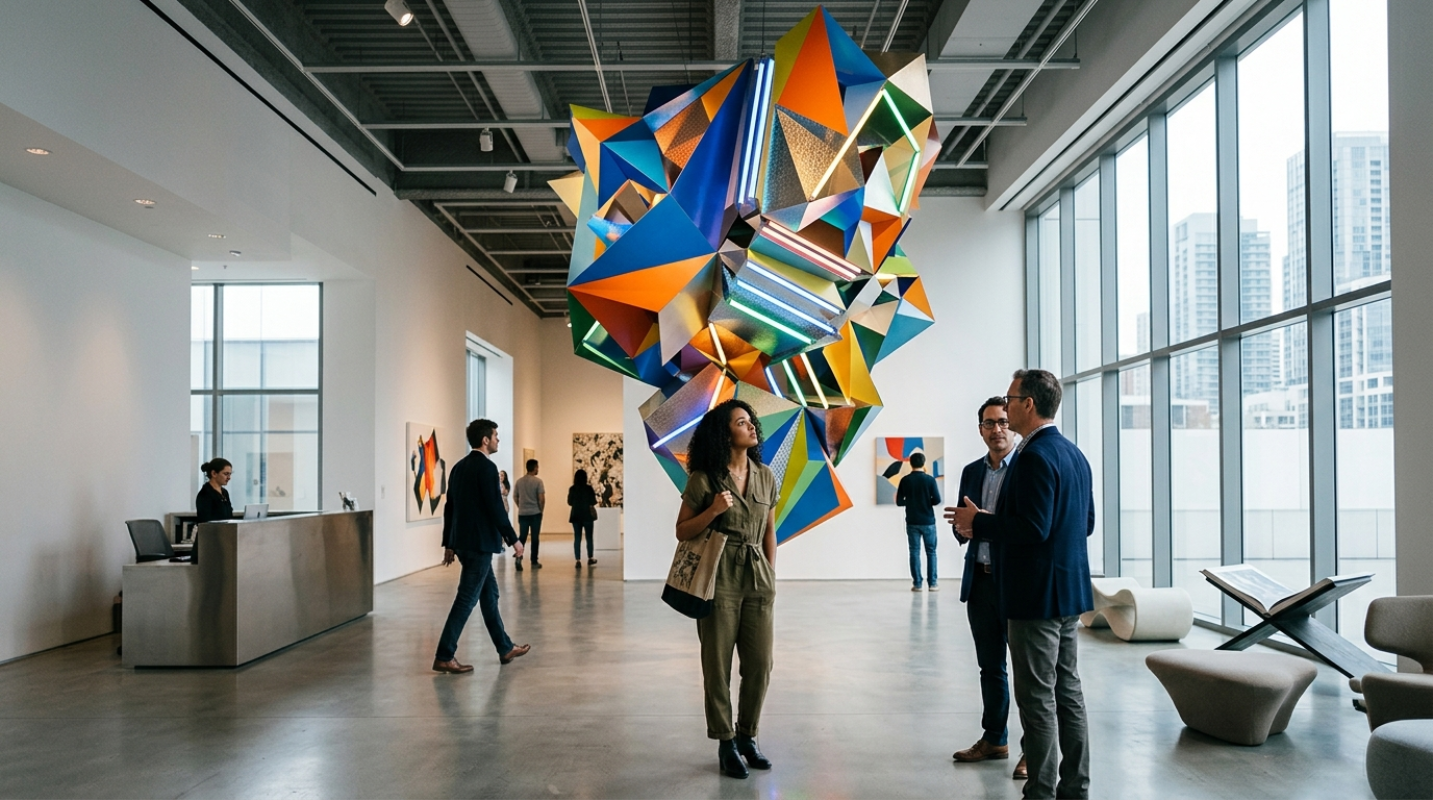
 (Image source: Gemini)
 Have you walked into a gallery lately and felt like you could actually live there? Not in the sense of wanting to move into a cold, hollow museum, but because the art itself feels like it belongs in a home. We’re currently living through a fascinating moment where the strict wall between "high art" and "interior design" is basically falling apart. It’s no longer just about hanging a frame on a white wall and standing three feet back. Today, art is something you experience with your whole body. It's something you sit on, something that grows on your shelves, and something that reacts when you walk past it. This shift is democratizing the way we appreciate creativity, making it less about status and more about how a space actually feels to inhabit.
Whether you’re a serious collector or just someone who wants their living room to feel less like a catalog, these movements are changing the game. From the "warm" evolution of minimalism to the strange, beautiful world of bio-art, here is how the art world is currently reshaping our physical and digital surroundings in 2026.
Neo-Minimalism Beyond the White Cube
You remember the "sad beige" trend from a few years ago, right? Everything was flat, white, and frankly, a bit boring. Well, the art world has officially moved on to something much more interesting called Neo-Minimalism. People are calling it "Warm Minimalism" in the design world, and it’s all about intentionality rather than just having nothing.
Instead of cold metal and sterile surfaces, artists are now obsessing over texture. Think of it like the difference between a plastic chair and a hand-carved wooden stool. You want to touch it. Curators are leaning into "slow art" that forces you to take a breath and actually look. A great example is the work of Bosco Sodi, who creates massive pieces using sawdust and raw pigments that crack and change as they dry.³ It’s imperfect, and that’s exactly why it works.
This movement has a massive grip on how we design our homes now. In fact, about 63% of people say they prefer minimalist designs that focus on well-being and calm.² It’s why you’re seeing so many lime-wash walls and "imperfect" organic silhouettes in furniture. We aren't just trying to own less stuff. We’re trying to make sure the stuff we do own has a soul.
Recent gallery shows like the "ROOMS" exhibition at Arden + White have shown that art shouldn't just sit on a wall. It should define the volume of the room itself. When you choose a piece of Neo-Minimalist art, you’re basically choosing the "vibe" of the entire space, not just a decoration.
Digital Surrealism and the AI Renaissance
If Neo-Minimalism is the deep breath, Digital Surrealism is the weird, vivid dream you have right before you wake up. Now that AI and VR are part of our daily lives, artists are using these tools to create things that look like they shouldn't exist in the physical world. It’s the digital equivalent of a Salvador Dalí painting, but it’s moving and reacting to you.
Major institutions have finally stopped gatekeeping digital art. At the most recent Art Basel, they even launched a dedicated section for new media called "Zero 10." It’s a big deal because it means digital files are being treated with the same respect as oil paintings. And the money is following. Over half of high-net-worth collectors bought digital art in the last year.¹
So how does this affect your home? It’s showing up as "Functional Art." Designers are making furniture that looks like a digital glitch or a melted object. You’ve probably seen pieces like
- The Playdough Chair by Kar Studio: It looks like something a giant child squeezed out of clay, defying the usual rules of furniture geometry.
- The X Lampe by Duen Studio: This piece uses light and form to create a "distorted reality" look that feels like it was pulled straight from a computer screen.
Artists like Refik Anadol are even creating "AI data paintings" that use millions of points of information to create fluid, moving visuals. It’s a bit controversial, sure. Some people worry that algorithms are taking over creativity. But others see it as a brand-new brush that we’re only just learning how to use.
Bio-Art and Eco-Conscious Design
This is arguably the most radical shift we’ve seen in decades. For a long time, art was about representing nature. Now, art is literally made of nature. We’re talking about "growing" art instead of building it. This movement, often called Bio-Art or Material Ecology, treats living organisms like mycelium (fungus) and algae as co-creators.
Neri Oxman is a huge name here. She’s been pushing the idea that we shouldn't just manufacture things, we should grow them.⁷ This isn't just some sci-fi experiment anymore. It’s hitting the luxury market hard because sustainability is the new status symbol. About 43% of younger buyers are specifically looking for "grown" materials when they shop for their homes.⁶
You can actually see this in action in modern galleries and high-end interiors
- Mycelium Panels: Companies like Mogu are working with architects to create acoustic panels made of fungus. They’re biodegradable and actually absorb sound better than traditional foam.⁶
- Bioluminescent Lighting: Artist Christopher Bellamy has a project called "Lucid Life" where he uses living algae to create lamps that glow blue when you touch them.
- Urban Lighting: In cities like Paris, companies are using bioluminescent bacteria to light up shop windows, which cuts down on electricity use.⁴
Galleries like BioBAT Art Space in New York are leading the charge here, hosting exhibitions that explore things like fruit-derived inks.⁵ It’s a shift from seeing the world as a resource to seeing it as a partner. It’s art that can eventually decay back into the earth without leaving a trace.
The Maximalist Revival Expressionism in Everyday Spaces
Now, if all that "warm minimalism" and "living fungus" feels a bit too quiet for you, don’t worry. There is a loud, colorful counter-movement happening at the same time. Maximalism is back, and it’s more active than ever. After years of being stuck inside and staring at grey walls, people are craving expression.
This isn't just about clutter. It’s about "curated chaos." In the gallery world, we’re seeing a return to bold Expressionism - clashing colors, heavy brushstrokes, and patterns that almost vibrate. This movement is a direct response to our need for optimism. It’s art that says, "I’m here, and I have something to say."
You’ll see this influence in consumer branding and home decor everywhere. Think of it as the "dopamine decor" trend. People are pairing 1970s-inspired patterns with neon digital art and traditional oil portraits. It’s about personality. Although minimalism is about the "we," maximalism is very much about the "me." It’s your chance to turn your home into a physical autobiography.
Curating Your Own Aesthetic
You don't need a million-dollar budget or a degree in art history to get involved. The "gallery-to-home pipeline" is more open than it’s ever been. The most important takeaway from these movements is that your space should be an extension of your curiosity.
If you like the idea of Neo-Minimalism, look for pieces with physical texture - something made of stone, raw wood, or thick, layered paper. If you’re into the digital side of things, maybe it’s time to look into a high-quality digital frame for your wall. And if you’re eco-conscious, keep an eye out for designers using mycelium or recycled bio-materials.
Art isn't a "finished" thing you just buy and forget about anymore. It’s a living part of your environment. Whether it’s a chair that looks like a glitch or a lamp powered by algae, the goal is the same: to make your daily life feel a little less ordinary.


.jpg)